Visiting an Australian Olive Oil Shop: What the Buying Experience Should Include
If an olive oil shop won’t let you taste before you buy, walk out.
I’m serious. Extra virgin olive oil is a living product, and “premium” printed on a label doesn’t mean a thing if the oil tastes flat, stale, or vaguely like crayons.
A good Australian olive oil shop feels part cellar door, part lab bench, part dinner-party advice booth. You should leave with a bottle you understand, not just one you were sold.
The moment you walk in: what you should notice (and what you shouldn’t)
Some places lead with vibe: warm lighting, pretty bottles, a few Italian words floating around like incense. Fine. But here’s the thing: real quality shops are built for scrutiny, not theatre, especially if you’re looking to purchase from an olive oil shop that actually takes freshness and provenance seriously.
You want:
– Tasting set-ups that protect the oil (dark cups or tinted glasses, not clear plastic shot cups sitting under downlights)
– Staff who talk harvest and milling, not “notes of sunshine”
– Batches you can trace (codes, dates, region, cultivar, actual specifics)
One-line test: Can they tell you when it was harvested without fumbling? If not, you’re buying blind.
A shop’s “flight” should feel like a map, not a menu
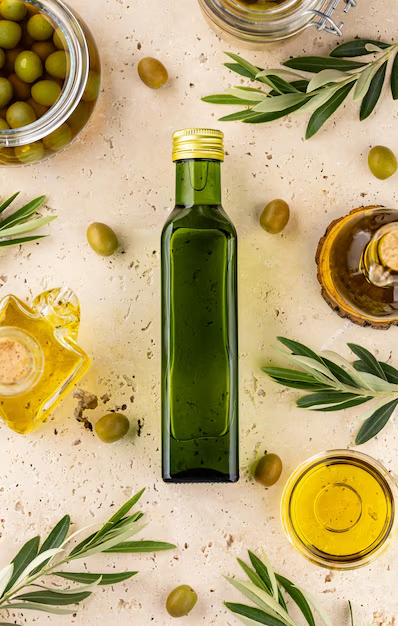
You’ll often see oils arranged as tasting flights: robust to delicate, inland to coastal, early harvest to late. That’s not just for fun. It’s education by palate.
A well-built flight makes regional and varietal differences obvious:
– Picual tends to hit with bitterness and a sturdy pepper finish
– Koroneiki often runs herbal, tight, and aromatic
– Frantoio/Leccino blends can lean elegant and grassy (in a good season)
Now, this won’t apply to everyone, but if you’re new to tasting, start mid-intensity. Jumping straight into a super-early harvest oil can feel like licking rocket leaves and chilli flakes off a spoon. Not pleasant. Not fair to the oil, either.
Question: What should staff actually do for you?
Not hover. Not recite a script. They should interrogate (gently) how you cook.
A solid consultant-style conversation sounds like:
– “Do you use oil mainly for finishing or cooking?”
– “Do you like bitterness, or does it annoy you?”
– “Is this going on grilled lamb, salads, seafood, or just weekday veg?”
– “How fast will you go through 500 mL?”
Because bottle size matters. I’ve watched people buy a gorgeous litre tin, use it twice, then wonder why it tastes dull two months later. Oxygen is undefeated.
Freshness: stop guessing and start reading
Olive oil doesn’t improve in the bottle. It declines. Slowly if you treat it right, quickly if you don’t.
So when you’re scanning labels, I’m looking for:
Harvest date (best), not just “best before.”
Best-before dates can be set generously. Harvest date is harder to fake and more useful.
A batch/lot code.
It signals the producer runs traceable production, not endless anonymous blending.
Region and cultivar clarity.
“Product of Australia” is decent. “Packed in Australia from imported oils” is the common trapdoor.
And yes, packaging counts. Dark glass and tins are your friends. Clear glass is a showroom choice, not a quality choice.
One data point that cuts through the noise: a chemical marker called free fatty acidity is used in standards for EVOO quality; extra virgin is typically defined as ≤ 0.8% free acidity under International Olive Council parameters (International Olive Council, Trade Standard for Olive Oils and Olive-Pomace Oils). That number won’t tell you if it tastes amazing, but it does tell you the producer is playing in the real rulebook.
Tasting like you mean it (not like you’re at a wine bar)
Look, you don’t need to be dramatic. You just need to be consistent.
Quick method that works in the shop
Warm the cup in your hand for 20, 30 seconds (like this), swirl once, then:
- Smell: fruity? herbal? ripe? flat?
- Sip small: let it coat your mouth
- Slurp a little air in: it lifts aromatics into your nasal passage
- Notice the three pillars: fruitiness, bitterness, pungency (pepper)
Pepper at the back of the throat is usually a good sign (fresh phenolics), not “harshness.” Bitterness can be gorgeous too, especially with food. The villain is rancidity: waxy, stale nuts, old sunflower seeds, cardboard. Once you smell that, you can’t un-smell it.
One short paragraph, because it matters:
Trust your nose.
Off-notes and red flags (I’ll be blunt)
If the shop pushes “light olive oil,” I lose confidence fast. That term usually points to refined oil, not extra virgin character. Same with “pure.” Pure what, exactly?
Other red flags I’ve seen:
– No harvest information anywhere
– Bottles stored in a sunny window
– Staff insisting colour equals quality (it doesn’t)
– One “award-winning” oil doing all the talking while the rest of the shelf stays vague
Awards can be legit, but they’re not freshness. They’re not your palate. They’re not tonight’s dinner.
Storage advice should be practical, not precious
You don’t need a climate-controlled vault. You need basic discipline.
Cool, dark, and tightly closed wins. Keep it away from the stove (that radiant heat is relentless). Use smaller bottles if you don’t cook with it daily.
In my experience, most home kitchens ruin olive oil by proximity, not by time: the bottle lives next to the cooktop because it’s convenient, and the oil gets gently baked day after day.
Pairing EVOO with Aussie food (because yes, it matters)
Pairing is where a good shop becomes genuinely useful. Australian food can be bold, charred, smoky, briny, so match intensity like you would with wine.
A few combos I’ve watched work over and over:
– Peppery, robust oil + grilled lamb (it cuts fat and plays nicely with rosemary/garlic)
– Green-herbal oil + charred asparagus or broccolini (echoes the bitterness, doesn’t fight it)
– Delicate, ripe-fruity oil + fresh goat cheese (you want lift, not a throat punch)
– Bright, citrus-leaning oil + seafood (snapper, prawns, scallops; finish at the end, don’t cook it to death)
Look, drizzle sparingly, taste, then adjust. The goal isn’t to announce the oil. It’s to make the food taste more like itself.
Transparency and sustainability: nice story or real proof?
Marketing loves the word “sustainable.” Real sustainability comes with receipts.
Ask questions that force specificity:
– “Do you know the grove or grower?”
– “Is this single estate or blended across regions?”
– “How was it harvested, machine, hand, mixed?”
– “Do they mill within hours of picking?”
If they can answer cleanly, you’re in a serious shop.
If they can’t, you’re in a bottle boutique.
The buying moment: what you should walk out with
Not just a bottle. A clear reason.
You should be able to say: This oil is from X region, harvested around Y time, it tastes like Z, and I’m using it for A and B dishes. I’ll store it properly and finish it within a sensible window.
That’s confidence. And honestly, that’s the whole point of going to a good olive oil shop instead of grabbing something random off a supermarket shelf.